Plunger Type Dial Gauge About
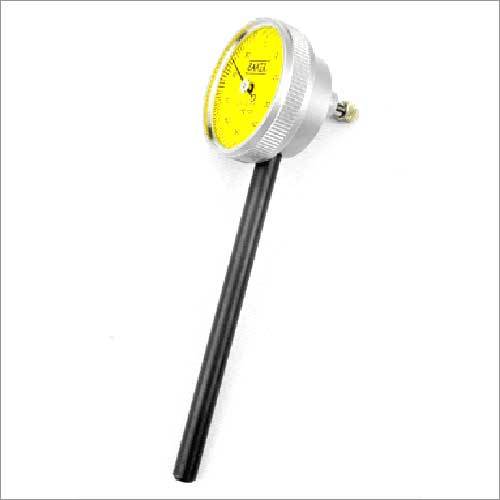
A plunger type dial gauge, also known as a dial indicator, features a cylindrical body housing a spring-loaded plunger and a dial face with a pointer. This tool is utilized for precise linear measurements in various engineering applications. The plunger is pressed against the object being measured, and the resulting displacement is indicated by the dial's movement. Its design enables accurate readings with minimal friction. Widely used in quality control, machining, and metrology, it excels in detecting small deviations and alignments. With high sensitivity and repeatability, its strength lies in its ability to provide reliable measurements in precision manufacturing processes.
Exceptional Accuracy and PrecisionEngineered for applications that demand high precision, this dial gauge delivers repeatable, consistent measurements with an accuracy of 0.01 mm. Its smooth linear plunger movement ensures users can reliably detect even subtle variations in dimension, making it a vital tool for machining, inspection, and laboratory work.
Durable Construction for Long-Term UseBuilt with a stainless steel case, chrome-plated finish, nitrile rubber seals, and a copper alloy Bourdon tube, the gauge is designed to withstand demanding industrial environments. Its shock-proof mechanism and corrosion resistance further boost its durability, ensuring extended service life and stable performance under frequent use.
FAQ's of Plunger Type Dial Gauge:
Q: How is the Plunger Type Dial Gauge used for precision measurement?
A: The plunger type dial gauge is pressed against the surface to be measured, causing the plunger to move. This movement, which is smooth and linear, is translated into a reading on the analog dial with 0.01 mm graduation, enabling highly precise measurement of linear displacement or thickness.
Q: What benefits does the shock-proof mechanism provide?
A: The shock-proof mechanism protects the internal components from accidental shocks or drops, maintaining the gauge's accuracy, reducing the risk of damage, and ensuring longer operational reliability in demanding work environments.
Q: Where is this dial gauge typically applied?
A: This dial gauge is widely used in machining units, inspection stations, and laboratories for applications such as component alignment, dimensional verification, and comparative measurements, where high repeatability and accuracy are crucial.
Q: What is the maximum temperature this gauge can withstand during use?
A: The dial gauge is designed to operate in environments with temperatures up to 60C, making it suitable for most industrial and laboratory conditions.
Q: How does the rotatable bezel enhance the measuring process?
A: The rotatable bezel allows users to easily set the dial to zero or align reference points, facilitating more flexible and accurate measurements without recalibration between uses.
Q: What materials contribute to the gauge's corrosion resistance?
A: Corrosion resistance is ensured by the use of stainless steel, chrome plating, and nitrile rubber seals, making the gauge suitable for various working environments and prolonging its operational lifespan.
Q: Can this dial gauge be mounted, and if so, how?
A: Yes, the gauge features a lug back mounting type, enabling secure attachment to stands or fixtures for stable and repeatable measurements during inspection or quality control processes.






 Send Inquiry


 Send Inquiry

